22 Jul Francesco and Veronica in the 800th Anniversary of the Death of the Poor Man of Assisi
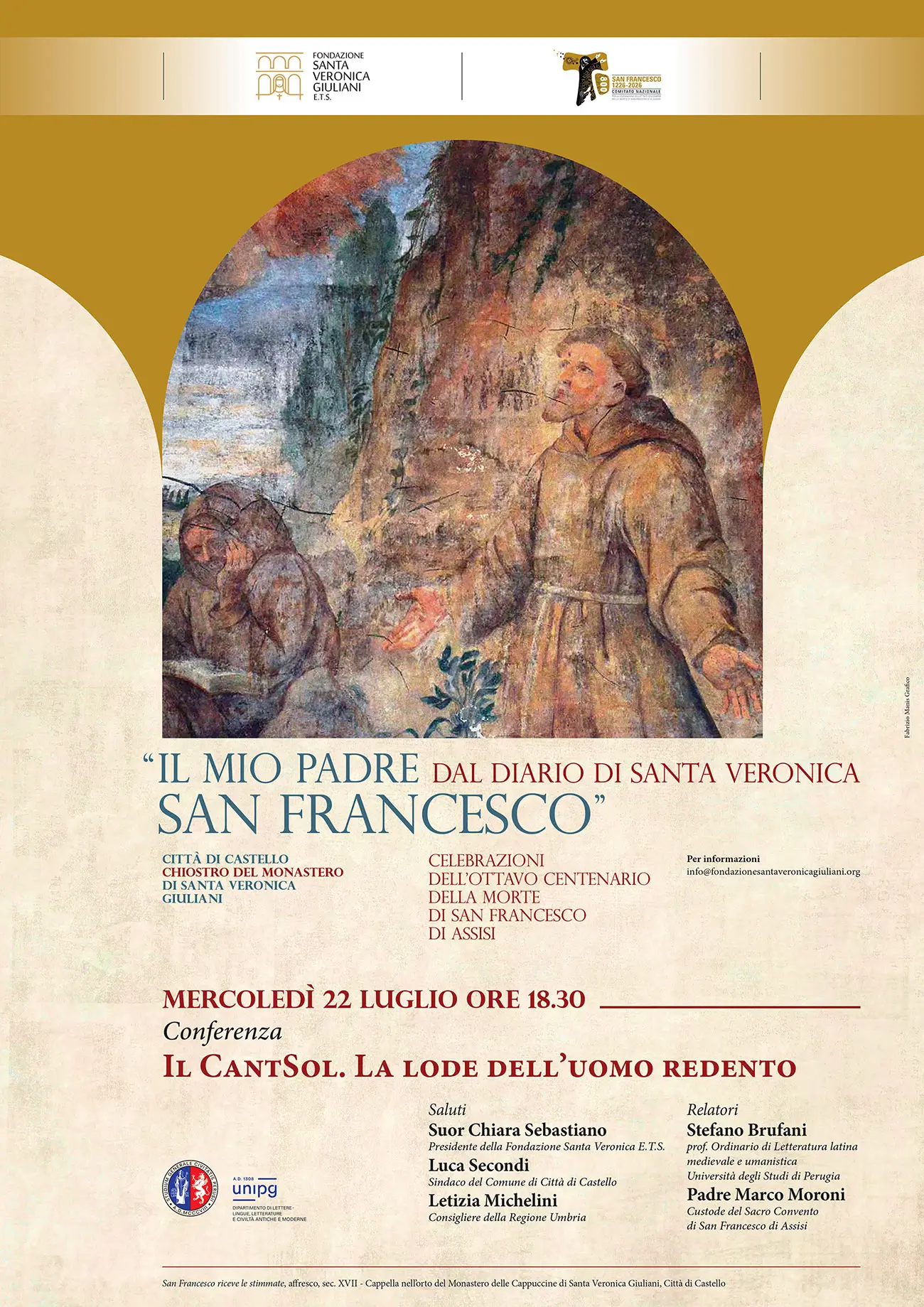
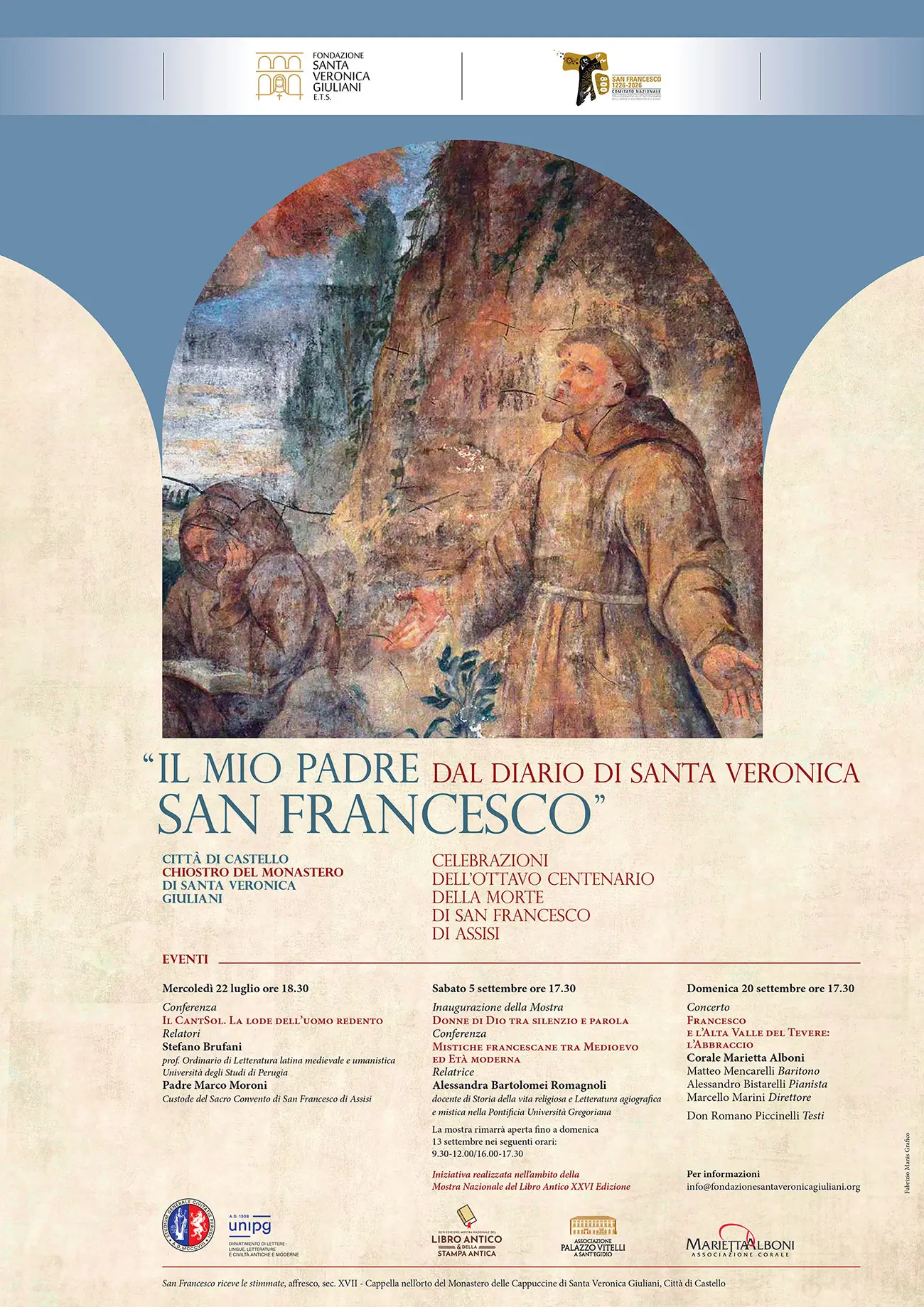
We are in the 800th anniversary of the death of Saint Francis, and the Santa Veronica Giuliani ETS Foundation—building on the deep bond that Saint Veronica shared with the one she called my Holy Father—has organized a series of events to celebrate his testimony and the fruits of holiness that have sprouted in the furrows of history across the centuries.
The first event on July 22 will feature Professor Stefano Brufani, Full Professor of Medieval and Humanistic Latin Literature at the University of Perugia, and Father Marco Moroni, Custos of the Sacred Convent of Assisi. They will engage in a dialogue starting from the Canticle of Brother Sun, viewed and re-read as the canticle of the redeemed man.
In September, an exhibition titled Women of God Between Silence and Word will be set up. The initiative is linked to the 26th National Exhibition of the Antique Book: texts concerning the Capuchin Saints and Blesseds, sourced from the Monastery Archive, the Diocesan Archive, and the personal collection of Atty. Paolo Tiezzi of Florence (President of the Tuscan Bibliographical Society), will be exhibited inside the cloister of the Santa Veronica Giuliani Monastery. The core of this event will be the conference delivered by Alessandra Bartolomei Romagnoli, professor of History of Religious Life and Hagiographical and Mystical Literature at the Pontifical Gregorian University, titled Franciscan Mystics between the Middle Ages and the Modern Era.
Closing this year of grace will be the concert-meditation offered by the “Marietta Alboni” Choir, directed by Maestro Marcello Marini: through texts prepared by Don Romano Piccinelli, the choir will bring the embrace of Francis to the significant places of the Upper Tiber Valley.
Thus, the year 2026 will conclude the celebration of the Franciscan jubilees and open us up to the “Veronican” jubilee: in 2027, in fact, we will celebrate the 300th anniversary of the death of Saint Veronica Giuliani. The Santa Veronica Giuliani ETS Foundation, in collaboration with the Municipality of Città di Castello and the Diocese, is working to ensure that this is a significant year for the territory and for the numerous pilgrims coming from all over the world.
The Franciscan Spirit of Saint Veronica Giuliani
Città di Castello was visited several times by Saint Francis, who in 1213 stayed at the hermitage of Buon Riposo near the town. Here, at the time of Saint Veronica, a convent was built, inhabited by the Observant Franciscans who were also present in the urban center alongside a community of Conventuals and, from 1538, Capuchins as well.
However, Saint Veronica was never spiritually guided by a Franciscan: the Blessed Sister Florida drew up a list of the names of 41 priests who had spiritual relations with Veronica; among them we find Oratorians, Servites, and Jesuits present in the town, but no son of Saint Francis appears. Indeed, there had been a prohibition in the Constitutions since 1529 stating that no Capuchin could take care of the Nuns. Nevertheless, the Monastery’s documentation shows the frequent presence of Capuchin preachers in the church of the Capuchin Nuns of Città di Castello.
All of this did not prevent Saint Veronica from deeply knowing Saint Francis through a spiritual and mystical experience and from living, like Francis, a path of total assimilation to Christ crucified.
The Spiritual Encounter Between Saint Francis and Saint Veronica
Veronica mentions at least 53 saints in her Diary: none occupies such a prominent place as Francis of Assisi. In fact, his name or the titles she gives him appear 118 times across the five volumes. He is followed in importance by Saint Clare of Assisi, mentioned 110 times. The relationships with Saint Francis and Saint Clare are not based merely on a mystical affinity, but on a filial bond that Veronica lived with fidelity and through an experiential union. Saint Francis, just like Saint Clare, is present in all the most important visions she experienced: they are for Veronica the mirror against which to measure herself on her path of conformation to the Crucified Spouse, through a total liberation of the heart via spiritual poverty.
The Capuchin mystic felt a profound call to be a worthy daughter of Francis and Clare. This desire for imitation was not limited to exterior observance, but extended to the very heart of the Franciscan experience: the sacred stigmata.
While in Saint Francis the gift of the wounds lasted about two years, in Saint Veronica the journey toward configuration to the Crucified One was a crescendo that lasted thirty years, from Good Friday in 1697 until her death.
The School of the Wounds: The Path of Mysticism
“To go to the school of his wounds”: with these words the Lord invited Veronica to understand the true meaning of religious life. On April 5, 1697, Good Friday, Veronica experiences her pentecostal day: the visible impression of the stigmata. Despite the formal differences in the mystical manifestations, the spirit is identical to that experienced at La Verna. Both Francis and Veronica were instruments of love, chosen from youth to bear witness to the redemptive suffering of Christ.
The mystic of Città di Castello lived this bond not in an abstract way, but through a vital union. In the visions reported in her Diary, the Saint of Assisi often appears as a new Christ, transformed by union with the Lord. This relationship confirms that, for Veronica, Franciscan spirituality is a “practical theology”: living Christ in one’s own flesh, day after day.
The Current Testimony of Saint Veronica
Today, in the context of a world that cries out for its need for integral ecology and reconciliation, the experience of Saint Veronica Giuliani resonates with extraordinary relevance.
Her invitation to “come to Jesus” is a universal appeal addressed to lukewarm souls and to every human being searching for meaning.
The figure of Veronica teaches us that the Franciscan charisma is an inexhaustible source of life. While the Saint of Assisi teaches us to praise God through the beauty of creation, Saint Veronica shows us how praise can flourish even in the desert of sorrow, transforming the cross into an altar of infinite love. In the jubilee year that we are preparing to celebrate in 2027, rediscovering the Saint does not mean merely studying a page of mystical history, but encountering a woman who, with her life, demonstrated that the love of God is the most precious good a human being can desire.
Conclusion
The bond between Saint Francis and Saint Veronica Giuliani is the seal of a spirituality that crosses the centuries without losing its vigor. Through the imitation of the “Seraphic Father,” Veronica was able to translate the message of the Gospel into an experience of intimate union with the Crucified Spouse. Her testimony, entrusted to the pages of her Diary, remains a constant invitation for every Christian: to find in Christ the only wealth, the only treasure, the source of a praise that, transcending the boundaries of time and space, unites all creation in the song of infinite Love.